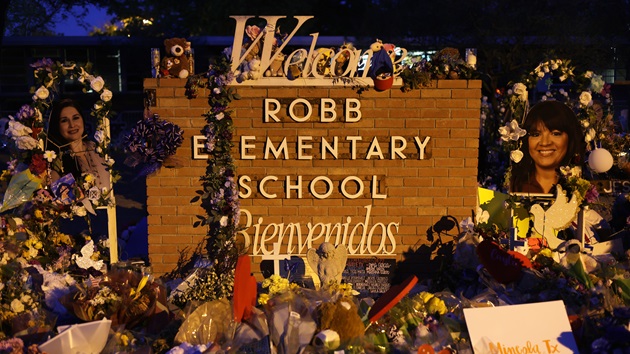
(CORPUS CHRISTI, Texas) -- Former Uvalde, Texas, school police officer Adrian Gonzales was alerted to gunman Salvador Ramos' location before Ramos entered Robb Elementary School, but Gonzales failed to act, prosecutors argued in opening statements on Tuesday.
Gonzales -- who is charged with 29 counts of child endangerment -- is alleged to have neglected his duty and training during the chaotic response to the 2022 shooting, which left 19 children and two teachers dead.
This case marks the second time in U.S. history that prosecutors have sought to hold a member of law enforcement criminally accountable for their response to a mass shooting. Gonzales' legal team maintains he's being scapegoated.
Prosecutor Bill Turner spoke softly and on the verge of tears at the start of his opening argument. His statement marked the first time prosecutors have provided their rationale for charging Gonzales, disclosing that a teacher came face-to-face with Ramos before the shooter entered the school, and the teacher tried to warn Gonzales.
"She's face-to-face with the gunman, and he fires on her, and she turns to run, and when she turns to run, she trips and she falls. And when she gets up, Adrian Gonzales, the police officer, is there," Turner said. "She says, 'He's over there.' She urges him to go get him."
"He gets on the radio and says, 'Shots are fired, he's wearing black, he's in the parking lot,'" Turner said. "He knows where he is, but Adrian Gonzales remains at the south side of the school."
As Turner walked the jury through the tragic minutes that followed that encounter -- describing the number of gunshots fired by Ramos as Gonzales allegedly waited outside -- Turner hammered at the point that Gonzales allegedly stayed where he was, rather than try to stop the shooting.
Defense attorney Nico LaHood told the jury that "pure evil" visited Uvalde on May 24, 2022, but said convicting Gonzales will not deliver justice.
LaHood argued that Gonzales did everything he could in that moment -- including gathering critical information, evacuating children and entering the school -- and said Gonzales acted on the information he had.
LaHood and his partner Jason Goss delivered a lengthy opening argument that used a map and time codes to provide the jury with a minute-by-minute view of Gonzales' actions.
"The government wants to make it seem like he just sat there, you know. He didn't just sit there -- he did what he could with what he knew at the time," LaHood said.
LaHood also called out the prosecution for planning to show the jury autopsy photos. The judge has preliminarily allowed prosecutors to show the images, but reserves the right to hold photos from entering evidence.
"They're going to really want you to focus on these photos, and I wish they wouldn't -- not because it hurts us -- because .. it hurts those precious people over there," LaHood said, pointing to some of the families and Uvalde community members in the gallery.
The first witness for the prosecution was Gilbert Limones, an employee of a funeral home near Robb Elementary, who testified about the panic he experienced when he realized a man was firing toward students.
"I saw him walking towards the south end of the building and then started at every window and just randomly would just get the gun and shoot inside the windows," he said.
In between his testimony, prosecutors played portions of Limones' frantic 911 call.
"Oh my god, he is about to shoot them. He is shooting at the people. Oh, Jesus," Limones told 911.
Limones described seeing a car crash and trying to aid the driver, but as he approached, the driver began shooting at him. He told jurors that the gunman walked towards the school "very nonchalantly" just moments before he started shooting at students on a playground.
Limones said he witnessed a white car -- driven by Gonzales -- drive past Ramos, missing an opportunity to take out the gunman.
"And then what happened?" a prosecutor asked.
"And then I just remember him going to the classrooms, and he started shooting window by window until he got to the door where he walked in through," he testified.
Despite nearly 400 officers responding to the shooting, law enforcement took 77 minutes to mount a counterassault to kill Ramos. Gonzales is one of only two officers charged in the case, along with former Uvalde schools Police Chief Pete Arredondo.
Judge Sid Harle seated a full jury after an emotionally fraught selection process on Monday. Dozens of potential jurors voiced frustration with the police response, and more than 100 excused themselves from the process, saying they did not believe they could be fair and impartial.
"They were only protecting themselves more than they were protecting the children," one dismissed juror told the court, as others cheered and clapped in agreement. "I would have sacrificed myself to save them, but they didn't. They just sat there."
Gonzales has pleaded not guilty, and his lawyers argue he is being blamed for a broader law enforcement failure. During the jury selection process, some voiced frustration that more officers have not been charged in the years following the tragedy.
"Are you saying this man is the whole problem? You are sticking it on his shoulders alone?" one dismissed juror remarked. "How many of them were out there? They should all be sitting there with him."
Gonzales was charged last year, along with Arredondo, the on-site commander on the day of the shooting. Arredondo's trial has been indefinitely postponed due to a pending civil lawsuit after the members of an elite tactical unit with the U.S. Border Patrol refused to speak with prosecutors about their involvement that day.
Gonzales' case is a rarity in U.S. law.
In 2023, a Florida jury acquitted Scot Peterson, a former Broward County sheriff's deputy, who was charged with child neglect and culpable negligence for his alleged inaction during the 2018 shooting at Marjory Stoneman Douglas High School in Parkland, Florida. Peterson's lawyers argued his role as an armed school resource officer did not amount to a caregiving post needed to prove child neglect in Florida, and that the response to the shooting was muddled by poor communication.
According to Bob Jarvis, a professor of law at Nova Southeastern University, prosecutors in the Gonzales case are likely to face the same legal hurdles that doomed the Peterson case.
"What you're really trying to do," he said, "is argue ... that being a coward is a crime, and that is very, very difficult."