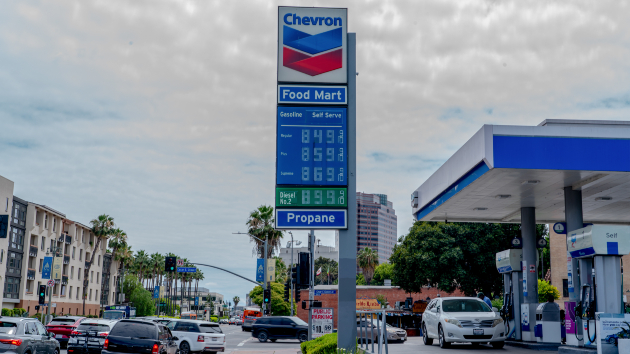
(LOS ANGELES) -- A Chevron gas station in Los Angeles elicited headlines in recent weeks for charging an eye-popping $8.71 a gallon, becoming an emblem for the spike in fuel costs set off by the Iran war.
Sky-high gas prices nationwide owe primarily to a historic oil shock that followed Iran’s effective closure of the Strait of Hormuz. But a lesser-known contributor helps account for just how high prices have gotten, at least at some name-brand stations selling fuel from the likes of Chevron, Shell and ExxonMobil.
Branded stations, which make up almost half of gas stations nationwide, charge about 6 cents more per gallon on average than their unbranded counterparts, according to data from the Oil Price Information Service (OPIS), a Dow Jones company, for the week ending on May 2. That price gap marks little change from where it stood before the war, OPIS data showed.
In at least one state, the price disparity runs significantly higher. Gas at a Chevron station in California costs an average of 48 cents more per gallon than the price at an unbranded station, the California Energy Commission (CEC) found in 2024. After Chevron, the most expensive average gas prices in California were found at Shell, 76 and Arco-branded stations, the CEC said.
Some analysts said the higher price of branded gas is due to additional costs, such as proprietary additives in the fuel, as well as a producer’s marketing budget and the payment forked over by stations for guaranteed access to its gas – costs that are passed on to consumers.
Other analysts and a California state watchdog, however, have said that the price disparity may stem from the market dominance of a handful of companies, allowing them to drive up the retail price.
The scrutiny comes as some large oil companies like British Petroleum, Valero and Marathon Petroleum report soaring profits amid the Iran war, though Chevron and Exxon saw profits decline due in part to one-time paper losses stemming from financial hedges meant to protect them against a possible price drop.
The price of an average gallon of gas currently stands at $4.52, an increase of $1.54 per gallon since the war began on Feb. 28, AAA data showed. That amounts to a nearly 52% jump in about two-and-a-half months.
Patrick Penfield, a professor of supply chain practice at Syracuse University, said the recent surge in prices could prompt a reexamination of the costs baked into the price at the pump, including the added charge for branded gas.
“When you see such big price increases for gasoline, everything should be looked at,” Penfield said.
Chevron did not directly respond to an ABC News request for comment. However, Jim Stanley, director of media relations at the Western States Petroleum Association, a industry trade group, contacted ABC News at Chevron's request.
Drivers choose branded gas stations as a matter of customer preference centered on issues like lighting, bathroom cleanliness or location, Stanley said.
"Any branded product – whether it’s medication or groceries or clothing – is going to generally cost more than a generic alternative," he added.
Stanley further said roughly 95% of branded gas stations operate as franchises, meaning they enter into agreements with big-name companies but retain self-ownership.
"Branded gas stations can have these brand standards that they hold their franchisees to: a higher standard than an independently owned store," Stanley added.
Kelly Davila, a spokesperson for Exxon, said the company doesn't "own or operate our retail stations."
Shell declined to respond to ABC News' request for comment.
Phillips 66, the parent company of 76, did not respond to ABC News' request for comment. Neither did Marathon Petroleum, the parent company of Arco.
Branded gas stations account for about 45% of stations nationwide, selling gas under the name of a major fuel company, OPIS data shows. Each of the brands touts a unique blend of additives that it says improves the gasoline and eases its effect on car engines. The extra ingredients go beyond the minimum standards mandated by federal and some state regulators, Denton Cinquegrana, chief oil analyst at Dow Jones Energy, told ABC News.
“At the end of the day, all gasoline has to meet a federal standard,” Cinquegrana said. “The branded gasoline goes above and beyond that minimum requirement.”
Higher prices charged by name-brand stations – a dynamic that stretches back decades – can be traced in part to spending on the development and production of the additives, Cinquegrana added: "They’re trying to recoup some of that investment.”
Some analysts, however, said it remains unclear whether the added ingredients deliver a meaningfully improved product.
“Regardless of each company’s claim, there is not sound evidence supporting the fact that additives do indeed improve the quality of gasoline, at least to the extent that the consumers perceive it to,” a study issued by the non-profit RAND corporation found in 2010.
The California Division of Petroleum Market Oversight (DPMO), a state watchdog agency, last year said it was "unable to independently verify claims that branded gasoline is superior to unbranded gasoline."
When asked about studies disputing the value of additives, Stanley, of the Western States Petroleum Association, declined to comment.
The higher price of branded gas also owes to marketing budgets borne by the big-name companies as well as elevated costs paid by retailers as part of agreements with the brands that guarantee them priority access in the event of a supply shortage, the U.S. Government Accountability Office said in a study of the issue published in 2005.
“Gas stations pay more for a contract for branded gasoline because they have a guarantee of supply. And they have a major global brand backing them up,” Cinquegrana said.
Some analysts and a California watchdog disputed those explanations. Rather, they said, the higher prices may reflect market power enjoyed by the large firms, giving them leeway to raise prices without fear of competition.
“My own reading of the data is that the branded companies are able to take advantage of a lack of a competitive market and are acting almost like an oligopoly,” Paasha Mahdavi, a professor of energy governance and political economy at the University of California, Santa Barbara, told ABC News, using a term that describes an industry dominated by a small number of companies.
Mahdavi focused on the relatively large price gap in California between branded and unbranded gas, which has widened in recent years.
In 2019, branded gas from companies like ExxonMobil, Arco, Valero and Chevron cost an average of 20 cents more per gallon in California; within five years, that price disparity had climbed to 31 cents, according to a DPMO study issued last year. Over that same period, the profitability of oil refiners in California has increased, DPMO said.
The rise in refinery profitability may be traced to the “exercise of market power by gasoline suppliers,” DPMO added, saying 90% of in-state refining capacity is controlled by four companies. As a result, elevated wholesale prices could be passed along the supply chain, DPMO said.
The largest companies appear to have “pretty strong control of not only upstream assets like oil and gas, but also control of the gas stations that are preferred by consumers based on location,” Mahdavi said. “They’re able to charge a higher premium.”
Valero did not respond to ABC News' request for comment.
Stanley, of the Western States Petroleum Association, said he is unsure why California features a larger gap in price between branded and unbranded gas than other states. One contributor, he said, could be the relatively low density of gas stations in the state.
"Competition brings down costs. When a retailer doesn't see that same level of competition, you can see that reflected in higher prices."
Stanley faulted environmental regulations in California for high overall gas prices.
"Branded or unbranded, gas in California is the most expensive in the country. That's because of supply constraints that have been created by state policies."
Mahdavi further said that the locations of branded gas stations may carry additional costs due to higher rents, accounting for some of the price gap.
The rise in prices during the Iran war offers an opportunity to revisit the factors that contribute to the price at the pump, according to Mahdavi.
“We can shine more light on what is driving these higher prices," he said.