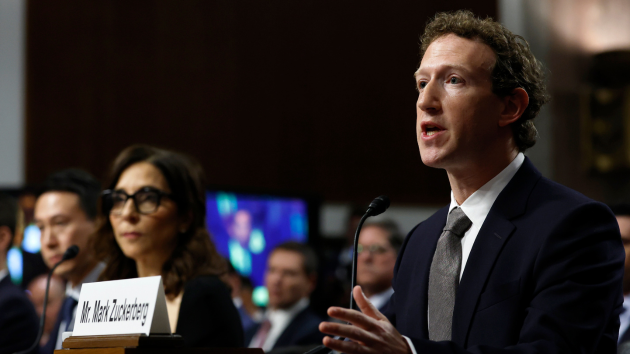
(WASHINGTON) -- Mark Zuckerberg took the stand on Wednesday in a landmark Los Angeles trial alleging that major social media platforms were intentionally designed to be addictive for children and teens.
The case, which began last Monday in Los Angeles County Superior Court, centers on claims against Meta -- the parent company of Facebook and Instagram -- and YouTube, which is owned by Google. Plaintiffs argue the companies knowingly built features that encouraged compulsive use among young users, contributing to long-term mental health harm.
The lawsuit was brought by a now-20-year-old woman identified as "Kaley" and her mother, who allege she was exposed to addictive design features as a child. Her lawyers claim she got hooked on social media apps starting as young as age 6. She says features like auto-scrolling got her addicted to the platforms -- ultimately leading to anxiety, depression and body image issues.
In his opening questions to Zuckerberg, Kaley’s attorney Mark Lanier asked if a company should "take advantage" of vulnerable people.
"I think a reasonable company should try and help the people who try and use its services," Zuckerberg said.
In tense exchanges in court, Zuckerberg admitted it is difficult for Meta to enforce age restrictions on Instagram.
Instagram’s policy states that children under age 13 are unable to create accounts. The plaintiff’s lawyer says Kaley started using the app at age 10, before those new restrictions were put in place.
"I always wish we would have gotten there sooner, but I think we're in a better place," Zuckerberg said.
Lanier also pressed Zuckerberg on alleged internal documents from Instagram head Adam Mosseri in 2022. In the documents, Mosseri said the evidence shows Instagram’s “primary goal” is to ensure people stay engaged with the app, especially among teens.
The attorney also submitted into evidence an email from Zuckerberg in 2016 claiming they aimed to increase time spent on apps by 12% over three years.
Zuckerberg acknowledged the company had previously established those goals but said “we changed that.”
Earlier in the testimony, Lanier questioned Zuckerberg over hisspeaking style and media training.
"I'm well known for being pretty bad at this," Zuckerberg said.
The case is the first of more than 1,500 similar lawsuits nationwide to go before a jury, potentially setting a precedent for how tech companies are held liable for product design.
Zuckerberg has appeared before Congress multiple times to address concerns over youth safety and online harms, but Wednesday marks the first time he will testify before a jury on these claims.
Several parents of children who died by suicide or accidental harm linked to online trends are expected to attend the proceedings. Some previously watched Zuckerberg apologize during a 2024 Capitol Hill hearing, where he acknowledged families who said social media contributed to their children’s deaths.
The companies deny the allegations, arguing that mental health outcomes are shaped by a range of factors beyond social media use. They say they have implemented safeguards aimed at protecting young users, including parental controls and accounts designed specifically for teens.
In a statement to ABC News at the start of the trial, a Meta spokesperson said, "We strongly disagree with these allegations and are confident the evidence will show our longstanding commitment to supporting young people."
Meta said that the company has made "meaningful changes" to its services, such as introducing accounts specifically for teenage users.
Zuckerberg's appearance follows testimony last week from Mosseri, who disputed characterizing Instagram use as an "addiction," while acknowledging what he described as "problematic use."
Mosseri testified that there's always a tradeoff between "safety and speech," saying users don't like it when they remove options from Instagram.
The Los Angeles trial is part of a broader wave of litigation targeting social media companies. Meta is also facing a separate child safety lawsuit in New Mexico, while lawsuits brought by school districts -- modeled after tobacco litigation in the 1990s -- are expected to head to trial later this year.
Social platforms Snapchat and TikTok were previously named in the lawsuit but reached settlements with the plaintiffs last month.