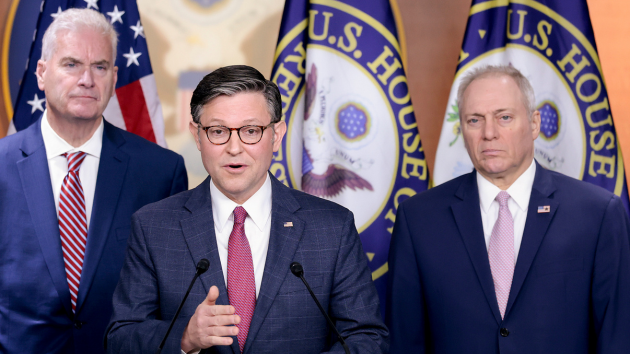
(WASHINGTON) -- House Republicans -- led by Speaker Mike Johnson -- unveiled Friday a narrow health care package to address rising costs, but the plan does not extend the expiring enhanced Affordable Care Act subsidies.
The GOP proposal -- which will receive a vote on the House floor sometime next week -- would expand the availability of association health plans and what are known as "CHOICE arrangements"; impose new transparency requirements on pharmacy benefit managers to lower drug costs; and appropriate money for cost-sharing reductions to reduce premiums in the individual market.
Association health plans allow employers to band together to purchase coverage.
Notably, the 111-page measure would not funnel additional money into health savings accounts.
"While Democrats demand that taxpayers write bigger checks to insurance companies to hide the cost of their failed law, House Republicans are tackling the real drivers of health care costs to provide affordable care, increase access and choice, and restore integrity to our nation's health care system for all Americans," Johnson said in a statement Friday.
Republicans are also discussing staging a vote on an amendment to the health care package that would extend the ACA subsidies. The specifics of the amendment are still being discussed, according to GOP leadership aides.
The Rules Committee plans to mark up the bill at 2 p.m. on Tuesday. The House would then have to vote on an amendment related to extending the subsidies and then the underlying bill before sending it over to the Senate.
Speaking to reporters on Friday, President Donald Trump said he wants a health care plan that would directly funnel aid to patients, adding that money should be given to people for health care through an insurance account.
"I think what most Republicans want to see– what is what I want to see, and I leave it to them, and hopefully they're going to put great legislation on this desk right here: we want to see all of the money that's been squandered and given to insurance companies because Obamacare is horrible health insurance," Trump said.
He added, "And we want the money to go to the people. They'll go in the form of an insurance account, health care account, or any other form that we can create with a lot of different forms. We want to give the money to the people and let the people buy their own great health care, and they'll save a lot of money, and it'll be great," he continued.
But Trump also kept the door open, slightly, on extending ACA tax credits, saying he was going to "look into" the possibility of doing so with the assurance that an extension deal would come with some caveats that Republicans want.
House GOP leadership aides hope to pass the health care package next week -- the last legislative week of 2025 that the House is expected to be in session for.
"The Lower Health Care Premiums for All Americans Act will actually deliver affordable health care -- and we look forward to advancing it through the House," Johnson said.
Even if the measure does clear the House, the Senate is not likely to take any further major action on health care next week, leaving those enhanced premium subsidies all but certain to lapse.
House Democratic Leader Hakeem Jeffries called the Republican proposal "toxic legislation" that doesn't address the coming hike in ACA premiums.
"House Republicans are not serious about ending the healthcare crisis they have unleashed in this country," Jeffries said in a statement. "After promising legislation for months, this 11th hour measure fails to extend the Affordable Care Act tax credits that tens of millions of Americans rely on to afford their healthcare."
Jeffries said Democrats are willing to work with Republicans on extending the subsidies, saying: "We are ready to work with anyone in good faith on the other side of the aisle who wants to prevent the Affordable Care Act tax credits from expiring at the end of the month."
Ahead of the measure being introduced Friday, nearly a dozen House Republicans had publicly defied Johnson by trying to force a vote on extending the expiring subsidies.
As of Thursday, 11 Republicans had signed on to two discharge petitions -- one filed by a Republican and the other by a Democrat -- that would extend the subsidies.
In the Senate, two competing health care proposals aimed at addressing the expected premium spikes -- one championed by Democrats and the other by Republicans -- failed to advance earlier this week.