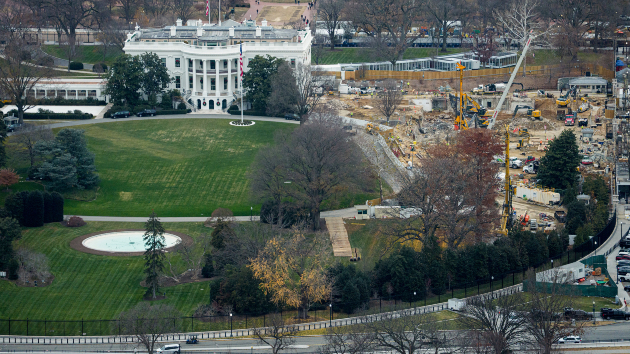
(WASHINGTON) -- Senate Republicans are aiming to secure $1 billion in funding for security-related aspects of the White House ballroom project as part of a broader, roughly $70 billion funding package for immigration enforcement, which they aim to pass with little-to-no support from Democrats.
Republicans began unveiling aspects of their reconciliation package late Monday night. Included within the bill is a $1 billion allocation to the Secret Service for "the purposes of security adjustments and upgrades ... relating to the East Wing Modernization Project, including above-ground and below-ground security features."
The funding can only be used for security-related aspects of the project, according to the bill text.
The Trump administration has previously said it aims to raise $400 million in private donations to pay for the ballroom, and has said it will cost the taxpayer nothing.
President Donald Trump said in October that the ballroom would be "paid for 100% by me and some friends of mine," referencing donors.
"The government is paying absolutely nothing," Trump said.
Democratic lawmakers have introduced legislation that they have titled "The Stop Ballroom Bribery Act" to regulate the project and impose restrictions on donations.
A group of GOP senators led by Sen. Lindsey Graham introduced separate legislation that would provide $400 million in funding. The senators on that bill say their proposal is to offset the cost of the ballroom by using customs fees. Because it is not in a reconciliation bill, it will almost certainly fail to pass if it even gets a vote on the Senate floor.
Republican Sen. Rand Paul put forward a separate bill that would authorize the ballroom but not fund it. He attempted to pass that by unanimous consent last week and it failed.
This bill text comes as Republicans have increasingly called for the construction of the ballroom following the shooting at the White House Correspondents' Association Dinner last month. They say a secure facility is necessary for the president and Cabinet members to gather with large groups on the White House grounds.
The White House said Tuesday that "Congress has rightly recognized the need for these funds."
"Due in part to the recent assassination attempt on President Trump at the White House Correspondents’ Dinner, the proposal would provide the United States Secret Service with the resources they need to fully and completely harden the White House complex, in addition to the many other critical missions for the USSS," White House spokesman Davis Ingle said in a statement. "As President Trump has repeatedly said, the White House must be a safe and secure complex that generations of future presidents and visitors to the People’s house can enjoy."
In a statement to ABC News on Tuesday, a spokesperson for Senate Judiciary Committee Chairman Chuck Grassley said the bill does "does not fund ballroom construction," but "provides funds for Secret Service enhancements that will ensure all presidents, their families and their staffs are adequately protected."
The ballroom has been the target of a lawsuit filed late last year by historic preservationists, with a federal judge finding it to be illegal without the approval of lawmakers.
In a filing in the case last month, the Trump administration said that the security enhancements to the East Wing project would include "missile resistant steel columns, Military-grade venting, drone-proof ceilings and bullet, ballistic, and blast proof glass," all aimed at forming a "fortified structural buffer" to protect not only the ballroom, but also the main White House residence and the offices in the West Wing.
That April 27 Justice Department filing, which read in part like a social media post written in the president's own voice, also said the upgrades would include "bomb shelters, a state of the art hospital and medical facilities, Top Secret military installations, structures, and equipment, protective partitioning, and other features."
District Judge Richard Leon ruled in late March that building the ballroom without congressional authorization violated the law. While Leon carved out an exception for work that would be necessary to ensure the "safety and security of the White House," he later clarified his decision to allow for "below-ground construction" on the project, as well as anything above ground that would be "strictly necessary" to secure and protect that work.
Leon’s injunction has been administratively stayed by a three-judge panel of the D.C. Circuit Court of Appeals, pending oral argument at a hearing set for next month. The appeals court's order means that, for now, work on both the ballroom and the project's security-related features can continue.
For weeks, Republicans have been working to put forward a funding package in response to political gridlock that left Immigration and Customs Enforcement and the U.S. Border Patrol without their regular annual appropriations. Though these agencies received funding through the previously passed One Big Beautiful Bill, Republicans say more funding is needed, and they’re looking to secure $26 billion for U.S. Customs and Border Protection and $38 billion for ICE in this just-released bill.
Republicans are aiming to pass the funding using a budgeting tool called reconciliation, which, if successful, would allow Republicans to send this funding to Trump's desk without the support of a single Democrat and without the possibility of a filibuster. But there are rules governing this process, and it’s not yet clear whether the Senate parliamentarian, who must determine whether items in a reconciliation package are "substantive to the budget," will green light the ballroom security funding or other items in the bill.
Senate Minority Leader Chuck Schumer said Tuesday that Republicans are "on a different planet" than American families with their spending priorities.
"Republicans looked at families drowning in bills and decided what they really needed was more raids and a Trump ballroom," Schumer wrote in a post on X Tuesday.