(NEW YORK) -- The United States continued to mount a naval blockade of Iranian ports in the Strait of Hormuz on Thursday, exerting financial pressure on Tehran while at the same time choking off a source of oil amid a historic global shortage.
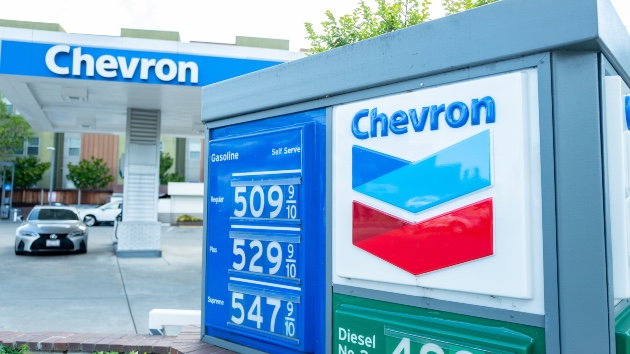
The move comes as Americans grapple with a surge in gasoline prices that threatens to eat away at household budgets and slow the economy.
Gasoline prices in the U.S. registered at $4.10 on average per gallon on Wednesday, standing about 35% higher than before the war, AAA data showed.
The blockade risks higher prices at the pump since oil trades on a global market, meaning a loss of supply in the Middle East could raise prices for Americans, some analysts said.
But, they added, the strategy may hasten a resolution of the war or reassure non-Iranian tankers otherwise hesitant to travel the strait, ultimately alleviating the oil shock and pushing down gas prices.
"This is an economic game of chicken," Tyler Schipper, a professor of economics at the University of St. Thomas, told ABC News.
Ten vessels have been turned around at the Strait of Hormuz during the first 48 hours of the U.S. blockade, complying with U.S. orders, according to U.S. Central Command.
On Wednesday, the commander of the Khatam Al-Anbiya Central Headquarters of Iran’s armed forces said the U.S. blockade of Iranian ports is a "violation of the ceasefire," in a statement published by the official Islamic Republic News Agency.
The war prompted Iran's effective closure of the Strait of Hormuz, a critical waterway that facilitates the transport of 20 million barrels of oil per day, or about one-fifth of the global supply.
Iran continued to export nearly 2 million barrels of oil each day through the strait, blunting some of the supply loss, according to energy data firm Kpler.
Still, in March, oil prices notched their largest one-month gain ever, the International Energy Agency said in a new report on Tuesday.
The potential loss of Iranian oil exports amid the blockade could deepen the supply shock and raise gasoline prices further, some analysts said.
"The move toward a full blockade of the Strait of Hormuz is compounding global supply concerns and risks further disrupting flows," GasBuddy petroleum analyst Patrick De Haan said in a post on X on Monday.
Car owners, De Haan added, "should prepare for another round of price increases."
Jason Miller, a professor of supply chain management at Michigan State University, echoed such concern.
"It's unclear to me how this moves to quickly solve the problem that vessels aren't transiting the Strait of Hormuz," Miller told ABC News. "Every day this continues, it gets worse and worse and worse."
Price hikes have not come to pass over the initial days of the blockade, however.
West Texas Intermediate futures price, the benchmark index for U.S. trading, clocked in at about $92 a barrel on Wednesday, marking a nearly 10% drop since the blockade began at 10 a.m. Eastern Time on Monday.
Even so, U.S. oil prices remain about 40% higher than pre-war levels.
The national average price of a gallon of gas as of Wednesday stood 1.4% lower than a week earlier.
The ceasefire between the U.S. and Iran entered its second week, appearing to boost hopes of a resolution to the war.
President Donald Trump reiterated his desire to wind down the conflict, meanwhile, saying the war is "very close to over" in a portion of an interview with Fox News’ Maria Bartiromo that aired on Tuesday.
Rather than restrict oil supply, the U.S. blockade could ultimately add crude to the market if the naval presence reassures non-Iranian ships otherwise unwilling to sail through the strait, Dominic Pappalardo, chief multi-asset strategist at Morningstar Wealth, told ABC News.
"For countries other than Iran, does the blockade give them more trust for sending oil through the strait?" Pappalarado said. "If other countries start to gain confidence, you could see other shipments pick up for non-Iranian vessels pushing through the strait, which would help alleviate upward pressure on the price."
As of Monday, tanker traffic remained well below pre-war levels after the blockade had taken effect, Kpler said in a post on X. Six vessels sailed through the strait on Monday, Kpler said, marking a decline from 14 vessels a day prior.
The conditions in the strait remain in flux, some analysts said, leaving a wide range of possible outcomes.
"There's still tremendous uncertainty," Miller said.