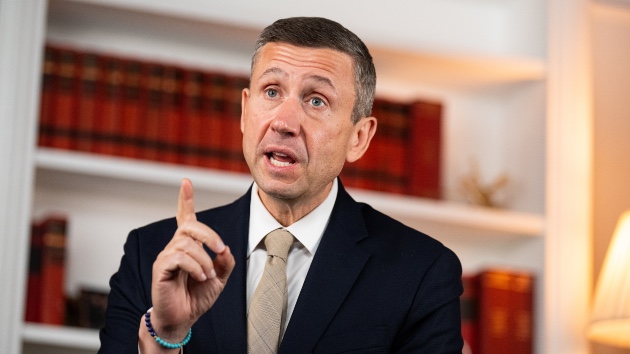
(WASHINGTON) -- Members of the Democratic National Committee voted down a symbolic resolution aimed at curbing the "growing influence" of "dark money" corporate groups in Democratic primaries that specifically called out the American Israel Public Affairs Committee (AIPAC).
Committee members gathered on Thursday in New Orleans, where a majority of members objected to the resolution for singling out AIPAC and argued it was redundant, since they had already approved a broader measure earlier in the meeting condemning the influence of dark money in the midterms without naming specific groups.
Allison Minnerly, who sponsored the resolution, responded to the criticism that her resolution was singling out AIPAC, the pro-Israel political lobbying group.
"Members like to say that we don't want to single out AIPAC, but AIPAC will entirely single out them and all of our different progressive leaders when it comes to primary elections," said Minnerly.
AIPAC’s influence has become a flashpoint inside the Democratic Party, as leaders struggle to respond to rapidly shifting views about Israel among progressives, especially in the wake of the war in Gaza and amid the current U.S.-Israeli war with Iran.
DNC Chair Ken Martin posted on X, stating, "We had various resolutions that focused on different industries and groups, and instead of going one-by-one, we passed a blanket repudiation."
The panel's rejection of the AIPAC resolution means it will not go before the full body for a final vote on Friday.
"The DNC made clear today that all Democrats, including millions who are AIPAC members, have the right to participate fully in the Democratic process, and we plan to do just that," AIPAC spokesperson Deryn Sousa told ABC News.
Minnerly's resolution stated that "the use of massive outside spending to support or oppose candidates based on their positions regarding international conflicts or foreign governments raises concerns about undue influence over democratic debate and policymaking, potentially constraining elected officials' ability to represent the views of their constituents," and referenced the millions of dollars spent by AIPAC in the recent Illinois Democratic primaries.
Andrew Lachman, a DNC member and the former president of California Jewish Democrats, said that it was "troubling" that the resolution was focused on calling out AIPAC.
"There are a lot of super PACs, a lot of right-wing organizations out there. There are a lot of left-wing ones out there that take advantage of the super PAC status as well. We need to address that," Lachman said. "None of those were mentioned ... I think respectfully, if it's about our campaign finance system, let's take it on. But when you mention only one group, it comes across like you're not actually interested in the campaign finance issue and transparency issue. It's about something else."
In a statement to ABC News, Brian Romick, the president and CEO of the Democratic Majority for Israel said, "We're pleased that the DNC Resolutions Committee rejected a set of divisive, anti-Israel resolutions. These measures would be a gift to Republicans, would further fracture our party, and do nothing to bring Israelis and Palestinians closer to peace."
“They should have voted for the AIPAC resolution given the pernicious influence they had in Illinois,” progressive Rep. Ro Khanna, D-Calif., told ABC News.
In a video posted on X, Khanna said, "anyone who wants to lead the party must condemn and reject AIPAC money.
2 other measures deferred
During the resolutions committee hearing, members also deferred action on two broad resolutions addressing Middle East conflicts, one of which would recognize Palestinian statehood and another that urged the party to support conditioning military aid to Israel. Instead, the proposals were sent to the party's newly formed Middle East working group.
The question of how productive this group has been was a topic of conversation from DNC members and was mentioned during the resolutions committee hearing.
"We recommend this going back to the task force, but then we can put som. ... expectations that we hear back," said Ron Harris, co-chair of the DNC's resolution committee, referring to the measure on Palestinian statehood.
Minnerly told ABC News she sponsored a measure to oppose the war in Gaza last August, but the resolution was defeated. In the wake of that, DNC Chair Ken Martin established a Middle East working group.
"I'm not surprised that members of the resolutions committee are eager for an update ... Since that meeting [in August], there has not been consistent progress or even forward motion, and the characterizations of the task force were accurate," said Minnerly, who is a member of the DNC's Middle East working group.
In recent weeks, progressives like Rep. Alexandria Ocasio-Cortez, D-N.Y., and Khanna have said they do not support any U.S. military aid to Israel, including defensive systems like the Iron Dome.
When asked if opposing funding for Israel's defensive systems is a stance more of the Democratic Party should represent, Minnerly told ABC News last week in advance of Thursday's meeting, "The further escalation has gone, the longer the war has been, we have seen the Democratic Party really migrate towards this ideal of de-escalation and not funding conflict."
Lachman, however, also speaking in advance of Thursday's meeting, said that he just sees this change in tune from some Democrats as "pressure from certain segments within the [Democratic Socialists of America]" and "some people who may be future candidates, particularly for president, are just trying to pander to them."
He added, "I don't think this is a mainstream view within the party, by any stretch of the imagination."