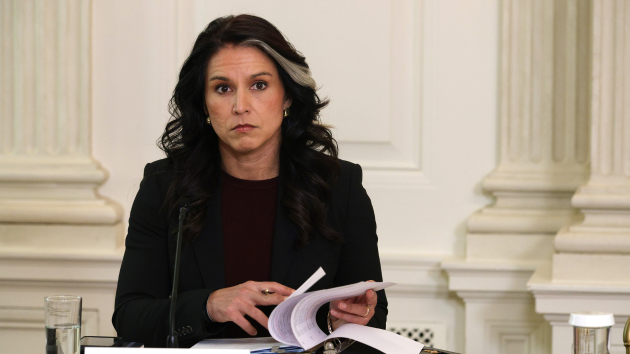
(WASHINGOTN) -- Director of National Intelligence Tulsi Gabbard is testifying on Capitol Hill on Wednesday, her clearest opportunity yet to address the intelligence picture surrounding the war in Iran.
Gabbard is appearing before the Senate Intelligence Committee for an annual hearing on worldwide threats. FBI Director Kash Patel, CIA Director John Ratcliffe and other national security officials are also testifying.
The hearing comes one day after the resignation of Joe Kent, the Trump administration’s top counterterrorism official, who stepped down over his objections to the Iran war. Kent's departure sharpened questions already hanging over the administration’s case for war, specifically whether Iran posed an imminent threat to the United States.
Lawmakers are expected to press Gabbard on Iran, homeland security concerns, election integrity and the broader global threat environment at a moment of rising tension.
Gabbard says Iranian regime appears 'intact' but 'largely degraded'
In her opening statement, Gabbard provided the latest intelligence community assessment on Iran.
On the country's current leadership, Gabbard said the regime "appears to be intact, but largely degraded due to attacks."
"Its conventional military power projection capabilities have largely been destroyed, leaving limited options. Iran's strategic position has been significantly degraded," she said.
She also warned that while "internal tensions are likely to increase" inside Iran as its "economy worsens."
"If a hostile regime survives, it will likely seek to begin a yearslong effort to rebuild its military, missiles and UAV [Unmanned Aerial Vehicle] force," Gabbard said.
On Iran's capabilities, Gabbard said they "previously demonstrated space launch and other technology it could use to begin to develop a militarily viable ICBM [Intercontinental Ballistic Missile] before 2035, should Tehran attempt to pursue that capability."
Gabbard said the assessment would be updated with the impact of the administration's military campaign "Operation Epic Fury."
Her remarks repeat an earlier assessment by the Defense Intelligence Agency before the U.S. and Israel began the war on Iran on Feb. 28. President Donald Trump, in justifying the military campaign, has repeatedly said an attack by Iran was "imminent" and that the U.S. was "very nearly under threat."
This is a developing story. Please check back for updates.