(LONDON) -- President Donald Trump on Monday threatened to "knock the hell" out of Iran if it tries to rebuild its nuclear program.
"Now I hear that Iran is trying to build up again, and if they are, we're going to have to knock them down. We'll knock them down. We'll knock the hell out of them," Trump said as he took reporter questions while welcoming Israeli Prime Minister Benjamin Netanyahu to his Mar-a-Lago club in Florida.
"But hopefully that's not happening," Trump continued. "I heard Iran wants to make a deal. If they want to make a deal, that's much smarter. You know, they could have made a deal the last time before we went through, you know, a big attack on them. And, they didn't decide not to make a deal. They wish they made that deal. So I think, again, they should make a deal."
Earlier this year, the U.S. attacked three of Iran’s nuclear facilities using bunker busting bombs and cruise missiles. Trump claimed that the U.S. “obliterated” Iran’s nuclear facilities, yet it’s unclear how far back their nuclear program was actually setback.
Trump on Monday also said he would support an Israeli attack on Iran if Iran continues with their ballistic missile and nuclear weapon program.
"The missiles, yes. The nuclear, fast. Okay. One will be, yes, absolutely. The other was, we'll do it immediately," Trump said.
Asked if he would support an overthrow of the Iranian regime, Trump said he was not going to discuss it.
"I mean, I'm not going to talk about overthrow of a regime. They've got a lot of problems they are in. They have tremendous inflation. Their economy is bust, they’re economy is no good. And I know that people aren't so happy," Trump said.
President Trump's comments come after Iranian President Masoud Pezeshkian said that Tehran is in a "full-scale" war with the U.S., Israel and Europe, describing the country's diplomatic situation as "complicated and difficult."
"In my opinion, we are in a full-scale war with America, Israel, and Europe; they do not want our country to stand on its feet," Pezeshkian said in a lengthy interview posted to the official website of Iran's Supreme Leader Ayatollah Ali Khamenei on Saturday.
"This war is worse than the war in Iraq with us; if one understands well, this war is much more complicated and difficult," Pezeshkian added, referring to the 1980-1988 Iran-Iraq war.
Pezeshkian said that despite sanctions and foreign pressure, Iran remains steadfast and capable of defending its national interests.
The interview was published ahead of Netanyahu's visit to the U.S., where Iran was among the topics expected to be under discussion.
Netanyahu's meeting with Trump was expected to be on advancing the Gaza peace plan, disarming Hamas, demilitarizing Gaza and the fate of the last hostage still remaining in the Strip, a spokesperson for the Israeli foreign ministry said before the Israeli delegation departed on Sunday for the U.S. The spokesperson added that Netanyahu's agenda is expected to include the "danger Iran poses" to both the Middle East and United States.
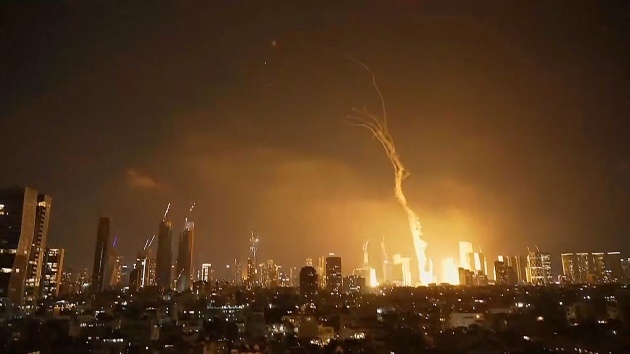
The U.S. and Israel attacked Iran in June during a 12-day conflict that killed some 1,100 Iranians and saw strikes against Iran's key nuclear facilities, its air defense network and prominent military and Islamic Revolutionary Guard Corps (IRGC) sites around the country.
Senior military, IRGC and nuclear research personnel were among those killed. Retaliatory missile attacks by Iran killed 28 people in Israel.
In the lead up to and during the June conflict, Netanyahu repeatedly hinted that Israel may pursue a regime change strategy in Iran, seeking to topple the Khamenei-led theocracy there. "This is your opportunity to stand up," Netanyahu said in an address to Iranians during the war.
Trump even raised the prospect of killing Khamenei in the days before the U.S. joined Israel's campaign. "We know exactly where the so-called 'Supreme Leader' is hiding," Trump wrote on social media. "He is an easy target, but is safe there -- We are not going to take him out (kill!), at least not for now."
The months since the conflict have seen little progress on a new deal to constrain Iran's nuclear program or cap its ballistic missile arsenal -- two goals long expressed by Trump.
Netanyahu met with Trump on Monday shortly after Iran conducted a major military exercise involving ballistic missiles. Referring to recent Iranian activity, Netanyahu warned last week that "any action against Israel will be met with a very severe response."
At home, the Iranian regime faces serious economic challenges as the country's currency -- the rial -- edged lower over recent weeks, causing widespread dissatisfaction and protests.
Over the weekend, groups of shop-owners closed their businesses in two large malls in downtown Tehran protesting the rapid drop in the value of the rial.
Pezeshkian was elected to replace late President Ebrahim Raisi -- who died in a helicopter crash in 2024 -- with the lowest turnout in the Islamic Republic's presidential election history. He was widely seen as a moderate alternative to hardliners aligned with the IRGC.